

Domain Security
Configuring Domain Defender Challenge Questions
Set up Domain Defender challenge questions to protect domain changes, transfers, nameservers, and contacts even after someone gains account access.
Fresh perspectives and practical advice, all in one place.
Set up Domain Defender challenge questions to protect domain changes, transfers, nameservers, and contacts even after someone gains account access.
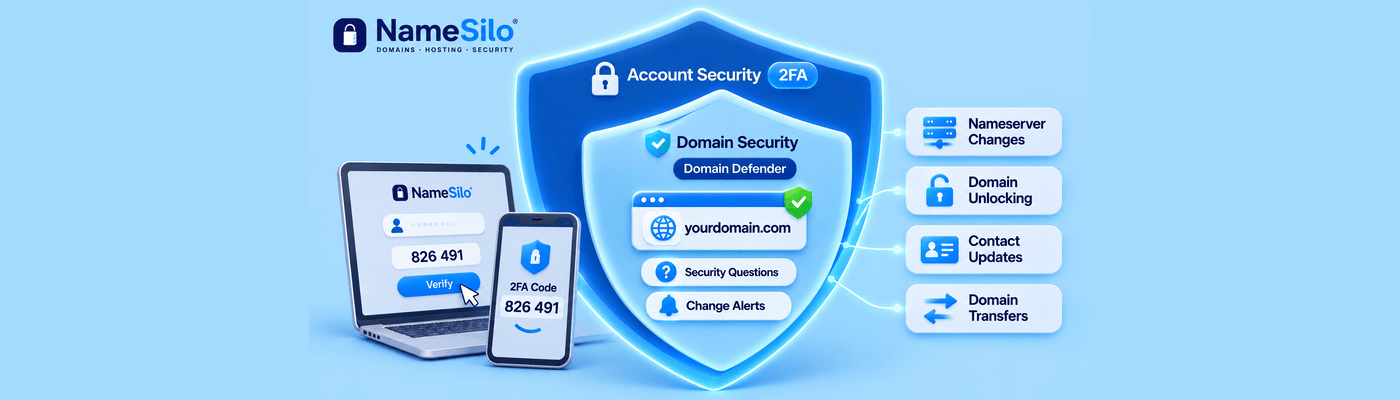
Learn how NameSilo 2FA protects account login while Domain Defender adds action-level protection for domain changes, transfers, and nameservers.

Defensive domain registration means buying alternate TLDs (.net, .co) and misspellings of your brand to prevent typosquatting and phishing. Configure 301 redirects to your main site and enable auto-renewal. NameSilo supports bulk search for up to 50 variants.

Learn how domain hijacking occurs, the common attack methods used by cybercriminals, and the best practices businesses can use to protect their domains.

UDRP is ICANN's dispute process for trademark claims. Complainants must prove the domain is confusingly similar, you have no legitimate interest, and you registered in bad faith. Ignoring a UDRP notice results in automatic loss. Respond within 20 days.

Is registry lock worth the cost for small businesses? Learn how it works, the risks it prevents, and when it makes financial sense.

Secure domains with registrar locks, 2FA, DNSSEC, and monitoring for nameserver changes. High-value domains need registry locks for offline verification. Most hijacks exploit weak email security, protect your WHOIS contact with dedicated credentials.

How does DNSSEC key rollover work? Learn how to rotate KSK and ZSK keys safely, avoid DS mismatches, and prevent SERVFAIL errors in 2026.

Learn how to stop unauthorized domain transfers with the right locks, 2FA, and monitoring. A step-by-step security checklist for domain owners.
Comprehensive breakdown of SSL, SEO effects, certificate types, and ranking implications.

Learn why even minor TLS certificate chain misalignments break Chrome, Safari, and Firefox. Understand the browser mechanics behind modern certificate validation

Deep dive into ACME domain validation challenges—HTTP-01, DNS-01, and TLS-ALPN-01—to choose the right method for reliable certificate automation.