Shared vs. VPS Hosting: Does Google Care About Your Server Neighbors?

If you have ever read a forum thread about SEO and hosting, you have likely encountered the phrase “bad server neighbors.” The idea is simple: if you share hosting space with spammy or malicious websites, search engines might associate your domain with their poor reputation. But how true is that? Can your rankings really suffer because of other domains on the same server?
As Google’s algorithms have evolved, so too has the debate about whether shared hosting can harm SEO performance. The reality is more nuanced. Shared hosting does not inherently hurt rankings, but server performance, uptime, and configuration can. Meanwhile, Virtual Private Server (VPS) hosting provides isolation and control that can reduce risks and improve site speed, both of which matter for SEO.
In this article, we break down the technical and search implications of shared versus VPS hosting. We look at how Google interprets shared infrastructure, when it becomes a problem, and how to choose the right environment for stability, scalability, and trust.
Understanding Shared Hosting
Shared hosting is the entry-level tier of web infrastructure. Multiple websites share the same physical server, storage, and processing power. Each account receives its own directory and access credentials, but the underlying resources are distributed among hundreds or even thousands of users.
The benefit is affordability. For small businesses, blogs, and early-stage projects, shared hosting provides an easy way to get online without managing hardware. The trade-off is limited control. You cannot modify system-level configurations or allocate extra memory when demand surges.
The shared environment also means one user’s resource consumption can affect another’s performance. If a neighboring site experiences a sudden traffic spike or runs inefficient scripts, it can slow down everyone on the same server. This latency affects both users and search crawlers.
However, from Google’s perspective, shared hosting itself is not a ranking penalty. The search engine focuses on page experience, speed, and reliability, metrics that depend on how well the hosting provider manages its environment.
How Google Sees Shared Servers
Google has publicly stated that being on shared hosting does not harm rankings. John Mueller, a senior search analyst at Google, confirmed that the search engine does not downrank domains based on server neighbors. As long as your site loads quickly and remains accessible, it is treated independently.
That said, server reputation still matters in edge cases. If a shared IP hosts a large number of spam or malware-distributing domains, some reputation-based filters may flag it temporarily. However, this is rare among reputable hosting providers that enforce strong abuse policies.
In essence, search engines evaluate performance and content signals at the domain level, not the IP level. The myth of bad neighbors only becomes a concern when the hosting provider fails to isolate accounts properly or allows security risks to persist.
The SEO Cost of Slow Shared Hosting
Speed is where shared hosting can indirectly influence rankings. When too many users compete for the same resources, response times increase. Higher Time to First Byte (TTFB) values lead to slower rendering, higher bounce rates, and reduced crawl efficiency.
Googlebot allocates crawl budgets based on performance. If your server frequently responds slowly or returns intermittent errors, the crawler interprets it as instability. This causes fewer pages to be indexed and delays in ranking updates.
In Crawl Budget Economics: Why Googlebot’s Time on Your Domain Is Now a Ranking Asset, we explored how every millisecond affects discoverability. Shared hosting amplifies this sensitivity; slow performance means less crawl coverage and fewer opportunities to rank.
VPS Hosting: The Next Step Up
A Virtual Private Server (VPS) bridges the gap between shared hosting and dedicated hardware. It partitions a single physical machine into multiple isolated environments, each with its own allocated CPU, RAM, and storage.
Unlike shared hosting, VPS users have administrative access and can install custom software, adjust performance settings, and implement advanced security protocols. The key advantage is resource isolation: another user’s high traffic or poor script performance will not slow your site down.
From an SEO standpoint, this isolation translates into consistent speed, uptime, and crawl reliability, all of which are core ranking factors. VPS hosting also allows you to fine-tune caching layers, database optimization, and compression, leading to improved Core Web Vitals scores.
Security Implications and SSL Management
One of the major distinctions between shared and VPS hosting lies in control over security. Shared hosting typically relies on provider-level firewalls and shared SSL implementations. While these protect most users, they cannot fully isolate accounts from each other.
In contrast, VPS hosting enables granular control over firewalls, SSH access, and SSL certificate deployment. With SSL Certificates, VPS users can configure domain-level encryption with full validation control. This not only enhances trust but also ensures HTTPS consistency across multi-domain or subdomain setups.
Search engines treat HTTPS as a ranking signal, meaning that secure configurations on VPS environments deliver measurable SEO benefits. The performance gains from SSL offloading and modern TLS compression further reinforce this advantage.
Uptime, Reliability, and SEO Continuity
One of the biggest advantages of VPS hosting is uptime reliability. While most shared plans advertise 99.9 percent availability, real-world performance can fluctuate. Scheduled maintenance or sudden overloads affect all users on the same server.
In Server Load Balancing and SEO: How Smart Routing Keeps You Visible During Traffic Spikes, we discussed how continuous uptime sustains search visibility. VPS environments contribute to this stability by offering dedicated system resources and the ability to scale on demand. This ensures that crawlers always find your site responsive and available, preserving ranking consistency.
VPS systems can also be paired with automated failover configurations, where traffic reroutes to a standby instance if the primary one fails. This type of redundancy is typically unavailable on standard shared hosting but has become a hallmark of modern, performance-focused infrastructure.
Cost Versus Control
Cost remains the most common reason users stay on shared hosting. For smaller projects, it makes sense, especially when combined with efficient caching and CDN integration. However, as traffic grows or when SEO performance becomes critical, upgrading to VPS offers long-term cost efficiency.
With VPS, you pay for guaranteed resources rather than shared capacity. The ability to control caching, database queries, and background processes often results in lower operational costs over time, as you can optimize your setup rather than rely on generalized server configurations.
For e-commerce sites or businesses managing multiple domains, this control is invaluable. Consistent uptime, faster response, and SSL integrity all translate into higher trust and conversion rates.
Shared Hosting for Beginners, VPS for Growth
The best approach is not choosing one over the other but transitioning when the time is right. Shared hosting works perfectly for personal projects, small blogs, or portfolio sites. Once consistent traffic growth or monetization goals emerge, moving to VPS ensures scalability and stability.
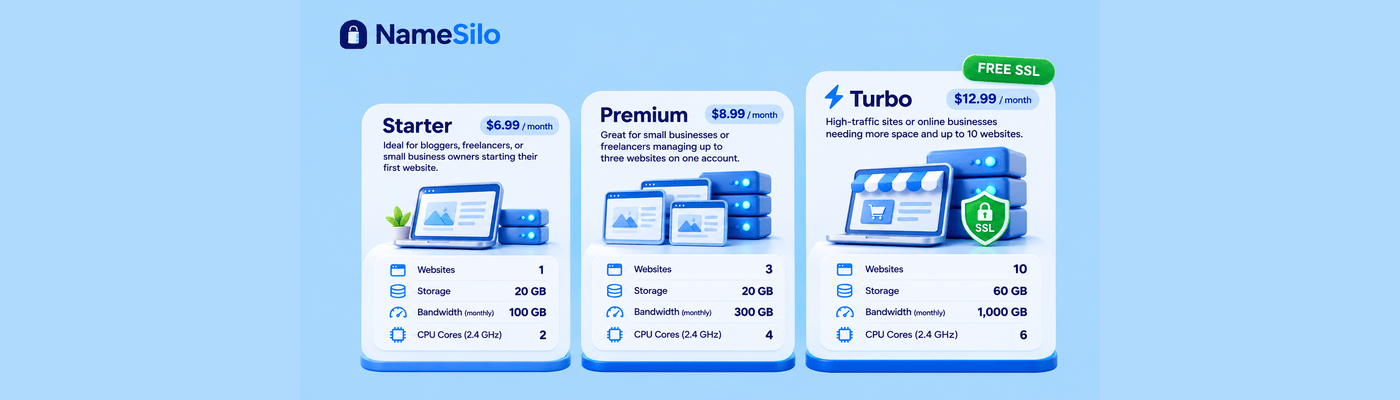
At NameSilo Hosting, customers can start with shared plans and upgrade seamlessly as their websites expand. This progression eliminates migration downtime and preserves SEO equity, ensuring smooth growth without disruption.
Google’s Perspective: Content Still Wins
Despite the technical nuances, Google’s primary focus remains content quality and user experience. A VPS can make a site faster and more reliable, but it will not compensate for weak content or poor structure. Shared hosting can rank just as well as long as it delivers stable performance.
However, technical reliability is a foundation for success. Fast, available, and secure websites create the conditions where good content thrives. That is why infrastructure decisions should be viewed as part of your overall SEO strategy rather than an afterthought.
The Myth of Shared IP Penalties
Another myth tied to shared hosting is that having multiple domains on the same IP address can hurt rankings. In reality, Google has explicitly clarified that this is not a ranking factor. Shared IPs are standard practice across hosting providers worldwide.
The only time shared IPs cause problems is when they are blacklisted for spam or malware. In such cases, the entire IP range may face temporary restrictions. Reputable registrars and hosting providers, such as NameSilo, monitor for abuse and maintain clean IP reputations to prevent this scenario.
Hybrid Hosting and the Future of SEO Performance
As hosting evolves, hybrid architectures are emerging, blending shared scalability with VPS isolation. These systems dynamically allocate resources based on demand, giving users the cost efficiency of shared hosting with the reliability of VPS performance.
This shift reflects a broader trend in SEO: infrastructure optimization as part of search strategy. Fast, resilient sites consistently outperform their slower counterparts, regardless of content quality parity. The rise of Core Web Vitals and AI-driven search ranking models continues to favor technical precision.
Choose Stability, Not Myths
Google does not penalize you for having server neighbors. What it rewards is stability, speed, and trust. Shared hosting remains an excellent starting point for new websites, but VPS hosting provides the performance foundation for growth.
When deciding between the two, consider where your website is today and where it is heading. If your audience is growing, your analytics show traffic spikes, or you manage multiple domains, upgrading to VPS hosting is not just an infrastructure choice; it is a ranking investment.
With scalable infrastructure, reliable uptime, and integrated SSL, you can focus on content while your server handles the rest.
NameSilo Staff
The NameSilo staff of writers worked together on this post. It was a combination of efforts from our passionate writers that produce content to educate and provide insights for all our readers.