The True Cost of Domain Privacy: Free vs. Paid WHOIS Protection

A domain can look inexpensive at checkout, but the registration price is only part of what you may pay to keep it. Some registrars charge separately for privacy protection every year. Bluehost, for example, currently lists Domain Privacy + Protection at $15 annually, while NameSilo includes WHOIS Privacy at no additional cost on eligible domains.
Over five years, that $15 add-on becomes $75 for a single domain before registration and renewal costs are even considered. For someone managing dozens or hundreds of domains, a seemingly small privacy fee quickly becomes part of the portfolio's annual carrying cost
The Two Price Tags of Domain Privacy
The difference becomes clearer once privacy is treated as part of the domain's ongoing cost rather than a one-time checkout decision.
Bluehost currently lists .com registration at $12.99, renewal at $23.99, and Domain Privacy + Protection at $15 per year. NameSilo's standard .com price is currently $19.99, with WHOIS Privacy included at no additional cost on eligible domains.
If today's prices stayed unchanged for five years, the comparison would look like this:
Registrar | Registration, Year 1 | Renewal, Years 2–5 | Privacy Over 5 Years | 5-Year Total |
NameSilo | $19.99 | $19.99 each | $0 | $99.95 |
Bluehost | $12.99 | $23.99 each | $75.00 | $183.95 |
The five-year totals are illustrative rather than a prediction of future pricing. They simply hold today's prices constant to show how recurring fees accumulate.
Even at NameSilo's standard rate, the difference becomes substantial over time because privacy never becomes another annual charge. In this example, the five-year difference is $84.00 for a single domain.
Customers enrolled in the NameSilo Discount Program can reduce that carrying cost further. The current entry-tier .com renewal rate is $12.00, while WHOIS Privacy remains free. At today's rate, that means an eligible .com can renew for $12.00 per year with privacy included, compared with $38.99 for a Bluehost .com renewal plus its annual privacy fee.
The Discount Program is optional and free to join from your first domain, although purchases must be made using Account Funds.
The Add-On Pricing Model
A low first-year registration price does not always reflect what a domain will cost to keep. Some registrars separate the domain itself from services such as privacy protection, which means those charges return alongside the renewal fee.
Bluehost currently lists .com renewal at $23.99 and Domain Privacy + Protection at $15 per year. Together, that makes the recurring annual cost $38.99 if you want to keep both the domain and its privacy protection.
NameSilo takes a different approach. WHOIS Privacy remains included at no additional cost on supported domains, so there is no separate privacy fee added when the domain renews. Customers using the Discount Program can also reduce the underlying .com renewal price further.
The important number, then, is not simply what a domain costs on the day you register it. It is what comes back every year you continue to own it.
The 5-Year Total Cost of Ownership (TCO)
A useful way to compare registrars is to look at the total cost of keeping the domain for several years rather than focusing only on the first checkout.
Using the current standard prices from the earlier comparison, a NameSilo .com held for five years would cost $99.95, or an average of $19.99 per year, with privacy included. The same five-year example at Bluehost totals $183.95 once its current renewal and privacy fees are included, averaging about $36.79 per year.
After the first year, the recurring difference becomes even clearer. A Bluehost .com renewal plus privacy currently costs $38.99 per year, while NameSilo's standard .com price remains $19.99 with privacy included. Customers enrolled in the NameSilo Discount Program can currently reduce the entry-tier .com renewal rate to $12.00 while keeping WHOIS Privacy at no additional cost.
Price, however, is only one part of the privacy calculation. Publicly exposed registration information has historically created costs that never appear on an invoice:
Spam and misuse. A 2013 Carnegie Mellon study commissioned by ICANN found that 43.9% of participating registrants reported experiencing at least one form of misuse that they associated with public WHOIS information.
Deceptive domain notices. Domain owners have long been targeted by renewal-style solicitations and other messages that use real domain information to make the approach look legitimate.
Impersonation and social engineering. Public ownership and contact information can give an attacker useful context when pretending to be a domain owner or approaching staff with a convincing account or transfer request.
Modern registration-data rules have reduced that exposure considerably, but the history explains why domain privacy became valuable in the first place.
Impact on Domain Portfolios
A recurring privacy fee becomes much more noticeable when it is multiplied across a portfolio.
At $15 per domain per year, privacy for 100 domains costs $1,500 annually. A portfolio of 500 domains would spend $7,500 every year on privacy alone, before renewal costs are considered.
For an investor with an annual sell-through rate of 1% to 2%, a 100-domain portfolio might produce only one or two sales in a typical year. At that rate, those sales would collectively need to absorb $1,500 in annual privacy fees before the investor has even accounted for registration and renewal costs.
That is why seemingly small add-ons matter in domain investing. A fee that barely registers on one domain can become a significant carrying cost across hundreds of names.
At NameSilo, eligible domains do not accumulate that privacy expense because WHOIS Privacy remains included at no additional charge.
The Post-GDPR Reality
The privacy landscape today is very different from the public WHOIS system of a decade ago.
Since GDPR took effect in 2018, registrars and registries have generally exposed far less personal registration data through public lookup services. ICANN's Registration Data Policy, which became effective on August 21, 2025, now provides the framework for how gTLD registration data is collected, transferred, published, and redacted.
That policy does not require every registration field to be hidden in every circumstance. Redaction is required where applicable law makes it necessary, and registrars and registries have some flexibility in other situations. Publication can also depend on the type of registrant and the particular data field.
The Registrant Organization field is one example. When an organization value is supplied and the registrant agrees to its publication, ICANN policy requires that value to be published.
So WHOIS Privacy today is not simply about preventing an otherwise completely public record from exposing every personal detail. It provides a more consistent privacy layer on supported domains, using proxy contact information rather than relying only on whatever redaction applies to a particular registration.
What This Means for You
At NameSilo, WHOIS Privacy is included at no additional cost on supported domains and enabled by default. Public lookups replace the registrant's contact information with PrivacyGuardian.org details, while you remain the actual registrant behind the domain.
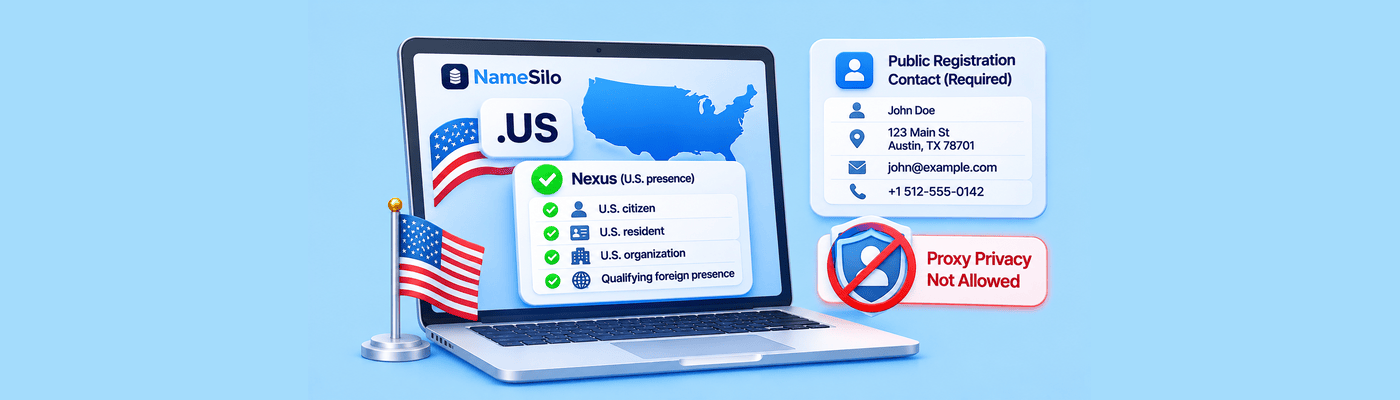
Not every extension permits this type of privacy service. NameSilo currently lists .us and .in as extensions where WHOIS Privacy is not allowed. .ca follows a different model: NameSilo's privacy service cannot be applied, but individual registrants may have their registration information hidden under the registry's own rules.
You can check or change privacy from Domain Manager using the Domain Privacy setting, then confirm what is publicly visible through the NameSilo WHOIS lookup.
When comparing registrars, look beyond the first-year registration price. Add the renewal rate, privacy fee, and any other recurring services you expect to keep. That gives you a much better picture of what the domain will actually cost to own.
Frequently Asked Questions
Why do some registrars charge for WHOIS privacy?
Privacy protection developed as a separate registrar service when WHOIS commonly exposed registrants' personal contact details. Some registrars still price privacy or related protection services separately, while others include them with the domain.
How much does domain privacy cost?
It depends on the registrar. At NameSilo, WHOIS Privacy is included at no additional cost on supported domains. Bluehost currently lists Domain Privacy + Protection at $15 per year.
Is free domain privacy safe?
The price of the privacy service does not determine how effective it is. NameSilo's WHOIS Privacy replaces publicly displayed registrant contact information with PrivacyGuardian.org details on supported domains, while NameSilo retains the actual registration information.
What is Total Cost of Ownership (TCO) in domaining?
It is the total amount spent to acquire and keep a domain over a chosen period, including registration, renewals, and recurring add-ons such as paid privacy. For investors, comparing annual carrying costs across an entire portfolio can be more useful than comparing first-year prices alone.
Why does NameSilo offer free WHOIS Privacy?
WHOIS Privacy is included as part of NameSilo's domain service on eligible extensions rather than being sold as a separate annual add-on.
Can I add domain privacy after purchasing?
Yes, if the extension supports it. You can manage WHOIS Privacy through Domain Manager.
Does GDPR make domain privacy free everywhere?
No. GDPR and ICANN registration-data rules affect what personal information may be publicly displayed; they do not determine what registrars charge for optional privacy services.
How do I enable free privacy at NameSilo?
Open Domain Manager and use the Domain Privacy setting for the relevant domain. Privacy is enabled by default on supported NameSilo registrations.
NameSilo Staff
The NameSilo staff of writers worked together on this post. It was a combination of efforts from our passionate writers that produce content to educate and provide insights for all our readers.