
Your next big idea starts with a name. Find yours
All articles
KEEP YOUR IDEAS GROWING

NameSilo Blog · Page 9

A little insight goes a long way. Find your next good read.

1,815 articles

Narrow your search

Keep typing, then choose where to search. Articles can match any checked field.

Search in
Sort by
Illustration of cPanel IP Blocker stopping a malicious IP address from reaching a website while allowing legitimate visitor traffic through.
Websites & Hosting

How to Block Malicious IP Addresses Using cPanel

Block malicious IPs via cPanel Security → IP Blocker, which writes Deny rules directly into .htaccess. Accepts single IPs, ranges, and CIDR blocks. Applies globally across all domains on the account. Always verify your own IP first to avoid locking yourself out.

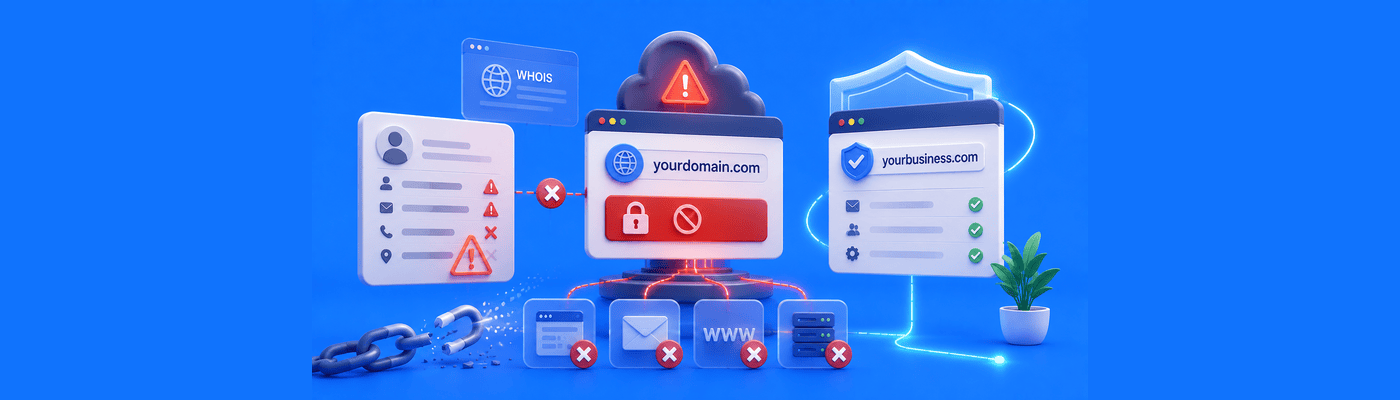
Illustration of WHOIS domain contact roles showing the Registrant as the domain owner with Administrative, Technical, and Billing contacts handling delegated responsibilities.
Privacy & Security

Registrant, Admin, and Tech Contacts in WHOIS Explained

WHOIS contact roles: Registrant (legal owner), Administrative (business decisions), Technical (DNS/webmaster), and Billing. Agencies should only ever hold Admin or Tech, never Registrant, to avoid legal liability and protect client ownership. NameSilo opts customers out of the standard 60-day registrant-change lock by default.

Illustration showing how fake WHOIS information can lead to domain suspension and clientHold status, taking a website and email offline, contrasted with accurate registrant details protected by WHOIS privacy.
Privacy & Security

What Happens If Your WHOIS Data is Fake?

Fake WHOIS data violates ICANN's Accuracy Program Specification and can trigger clientHold, taking your site and email offline. Registrant emails must be verified within 15 days. Skip the risk entirely with free WHOIS privacy, which protects your details without falsifying them.

Illustration comparing ALIAS and CNAME DNS records, showing a CNAME connecting a www subdomain to a cloud service and an ALIAS-style record connecting the root domain without conflicting with MX, NS, or email records.
DNS

ALIAS Records vs. CNAME Records: Which Do You Need?

RFC 1035 forbids CNAME records at a root domain because they conflict with MX and NS records. ALIAS, ANAME, and CNAME flattening are vendor-specific workarounds, not a DNS standard. NameSilo doesn't currently offer ALIAS/ANAME; use CNAME on www plus root forwarding, or delegate DNS to a provider like Cloudflare that supports it.

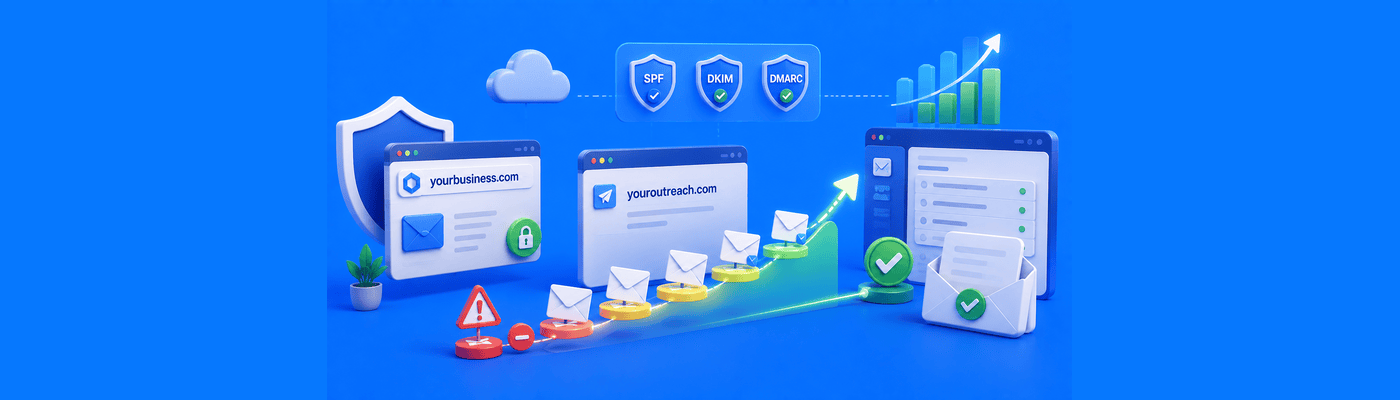
Illustration of warming up a new domain for cold email outreach by gradually increasing email volume, using SPF, DKIM, and DMARC authentication, building sender reputation, improving inbox deliverability, and keeping outreach separate from the primary business domain.
Email

How to Warm Up a New Domain for Cold Email Outreach

Warm up a new cold email domain over 4-8 weeks: start at 5-10 emails/day, scale to 40-50+ by week 6-8. Never send cold outreach from your primary corporate domain. Configure SPF, DKIM, and DMARC before day one. Favor vetted warmup tools over open shared engagement pools.

Modern illustration comparing a free Gmail address with a professional custom domain business email, showing branding, secure email authentication, DMARC, SPF, administrator controls, business ownership, spam protection, and trusted business communication.
Email

Why You Shouldn't Use a Free Gmail Address for Business

Free Gmail addresses damage business credibility, limit DMARC alignment for deliverability, and create a data ownership risk: the company has no legal access to an employee's personal inbox. Free email forwarding solves receiving but not sending. Custom business email costs little and solves all three problems.

Modern illustration showing the risks of free domain extensions such as .tk, .ml, .ga, and .cf, featuring abandoned websites, phishing warnings, cybersquatting, domain suspension, registrar changes, and the contrast between free domains and secure ICANN-backed domain ownership.
Domain Name Search

The Risks of Using Free Domains (.tk, .ml, .ga, .cf)

Freenom's free .tk, .ml, .ga, and .cf domains carried no real ownership rights. After a Meta cybersquatting lawsuit, Freenom halted registrations in 2023 and exited the domain business entirely in 2024, proving the repossession risk at massive scale. These TLDs are also heavily blacklisted for spam. Register a real, legally protected .com instead.

Modern illustration of an ACPA cybersquatting lawsuit showing a trademark owner challenging a bad-faith domain registrant in federal court, with trademark protection, disputed domain registration, WHOIS records, legal documents, and financial damages.
Domain Name Search

Understanding the ACPA: Suing for Bad Faith Domains

The ACPA (15 U.S.C. § 1125(d)) lets trademark owners sue cybersquatters in federal court for statutory damages of $1,000-$100,000 per domain, unlike UDRP which only transfers the domain. UDRP costs about $1,500 and takes 60 days; ACPA litigation can cost $20,000+. Educational content, not legal advice.

Modern SaaS illustration showing the launch phases of a new top-level domain, including Sunrise, Landrush, and General Availability, with domain registration, trademark protection, ICANN approval, registry infrastructure, and public domain availability.
Domain Name Search

What is a Top-Level Domain (TLD) Launch?

New TLDs launch in three phases: Sunrise (trademark holders only, via TMCH), Landrush (anyone, premium price, contested names go to auction), and General Availability (open, first-come-first-served). ICANN's second gTLD round closes applications August 12, 2026; new extensions won't register until 2028.

FROM IDEA TO REALITY

You’ve got the idea.
Give it a name.

Find a domain that feels like you. Build what comes next.