
Domain Name Search3 min
Domain Name Dispute Resolution: URS vs. UDRP
NS
NameSilo Staff10/7/2026
Share
This article is for educational purposes only and does not constitute legal advice. Consult a qualified attorney before filing an ICANN dispute proceeding.
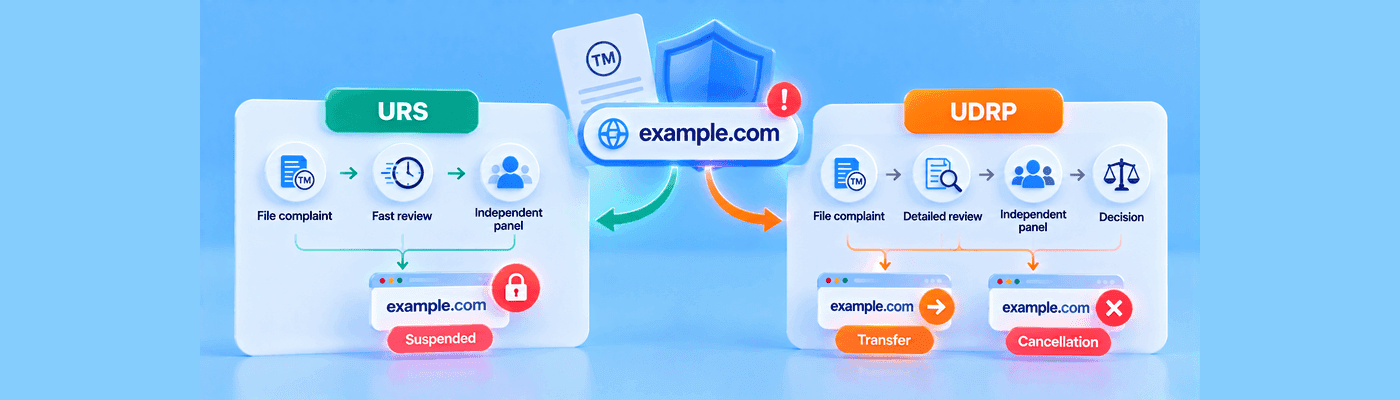
The Uniform Rapid Suspension (URS) system is a faster, cheaper alternative to the Uniform Domain-Name Dispute-Resolution Policy (UDRP). URS is designed for clear-cut, indisputable cases of trademark infringement and results only in the temporary suspension of the domain. UDRP is a more extensive arbitration process that allows the prevailing trademark holder to permanently transfer ownership of the domain to themselves.
ICANN's Out-of-Court Arbitration Mechanisms
Both URS and UDRP exist to let trademark holders recover or neutralize infringing domains without filing a federal lawsuit. Each is administered by ICANN-approved panels rather than a court, trading some procedural depth for speed and lower cost.
Deep Dive: The UDRP (The Gold Standard)
In place since 1999, UDRP remains the default choice for most disputes. Expect roughly two months from filing to decision, with single-panelist provider fees typically running $1,300 to $1,500. The evidentiary standard is a "preponderance of the evidence," the ordinary civil burden of proof. Critically, UDRP applies broadly across nearly all gTLDs, including .com, .net, and .org, and a successful complaint can result in either cancellation or full transfer of the domain to the trademark holder.
Deep Dive: The URS (The Quick Takedown)
URS moves fast: often resolved in a few weeks, sometimes in as little as ten days, at a fraction of the cost, typically $300 to $500. But the outcome is limited by design: URS only suspends the domain for the remainder of its registration term. It never transfers ownership; the domain stays registered to the same party, locked and displaying a standard notice page, and simply doesn't resolve.
A scope limitation worth knowing before you file: URS was introduced in 2013 alongside the first wave of new gTLDs and only applies to those newer extensions, not legacy TLDs like .com, .net, or .org. If your infringing domain sits on one of the original gTLDs, URS isn't available as an option at all; UDRP is your only ICANN administrative path. ICANN's next new gTLD application round opens April 30, 2026, meaning the pool of URS-eligible extensions will keep expanding in the years ahead.
Evidentiary Burdens
URS requires "clear and convincing evidence," a meaningfully higher bar than UDRP's ordinary preponderance standard. This exists specifically because URS's remedy is fast and its review is light; the higher threshold ensures the accelerated process only produces the right outcome in genuinely obvious cases, not close calls.
Common Mistakes
Filing a URS for a complex, nuanced dispute involving generic dictionary words: URS panels dismiss cases the moment any legitimate argument or ambiguity exists. A dispute over SilverStream.newgtld where "Silver Stream" is a plausible generic business name, rather than obvious brand theft, gets rejected outright, forcing a full UDRP filing anyway, after you've already spent the time and fee on URS.
What This Means for You
Confirm the current registrant and registrar of any domain in question via WHOIS. If you need assistance understanding how a domain in your account is affected by an active dispute, contact NameSilo Support directly.
Frequently Asked Questions
What is the difference between URS and UDRP?
URS is faster and cheaper but only suspends; UDRP can permanently transfer the domain.
How much does a URS proceeding cost?
Typically $300 to $500 in provider fees for a single domain.
Does URS transfer a domain name?
No. URS only suspends the domain for the remainder of its registration term.
What is a Uniform Rapid Suspension?
A fast-track ICANN process for clear-cut trademark infringement on new gTLDs only.
How long does a UDRP take?
Roughly two months from filing to a final decision.
Can I file a URS for a .com domain?
No. URS applies only to new gTLDs introduced since 2013, not legacy extensions.
What proves bad faith in domain registration?
Evidence the domain was registered and used specifically to exploit a trademark.
How does NameSilo handle domain disputes?
NameSilo administratively locks affected domains during active ICANN proceedings.

NameSilo StaffThe NameSilo staff of writers worked together on this post. It was a combination of efforts from our passionate writers that produce content to educate and provide insights for all our readers.
More articleswritten by NameSilo