

Domain Name Search
Cybersquatting vs. Legitimate Domain Speculation
Learn the difference between legitimate domain investing and cybersquatting, including bad faith, trademarks, typosquatting, and UDRP risk.
A little insight goes a long way. Find your next good read.
Learn the difference between legitimate domain investing and cybersquatting, including bad faith, trademarks, typosquatting, and UDRP risk.

Learn how .ai domain registration works, including its two-year minimum term, renewal rules, pricing structure, and global SEO treatment.

Learn how Account Funds work with auto-renewal to reduce failed domain renewals caused by expired cards, bank declines, or payment issues.

Learn how RDAP replaces WHOIS with structured JSON, including events, entities, redacted data, bootstrap routing, and programmatic lookups.
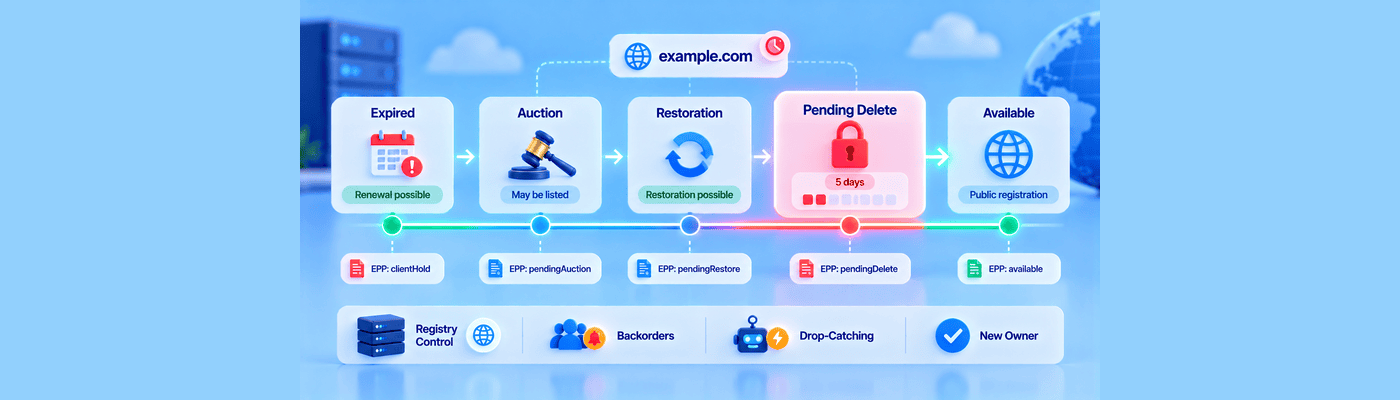
Pending Delete is the final, exactly 5-day phase (days 65-69 in NameSilo's expiration cycle) before a domain is deleted and released publicly. It's a registry-level lock no registrar can override. Verisign shifted the .com/.net drop time to around 12:00 UTC effective October 2026. Catch it via automated backorder through Catch.club.

Compound .com domains fuse two real words into a brandable name, valued by grammatical flow (Noun+Noun, Verb+Noun, Adjective+Noun), affix quality (Get-, Try-, -Hub, -Lab), and commercial relevance. Real companies like GetResponse, CoinBase, and DoorDash prove this naming convention, valued $1,500-$25,000 in the aftermarket.

A DNS amplification attack spoofs the victim's IP to trigger massive reflected responses from open resolvers, using EDNS0's larger buffer sizes (up to 4096 bytes) to turn a 60-byte request into a 3,000-byte response, roughly 50x amplification. Mitigation includes Response Rate Limiting, closing open recursion, and upstream scrubbing.

Explore typo traffic arbitrage, the legal difference between generic misspellings and typosquatting, and whether domain parking still pays in 2026.

Learn the difference between recursive DNS resolvers and authoritative nameservers, how caching works, and where each fits in a DNS lookup.

Learn how glue records work, why custom nameservers need them, and how agencies can configure branded nameservers such as ns1.yourdomain.com.

EPP status codes come in two layers: client codes (set by your registrar, self-removable, like clientTransferProhibited) and server codes (set by the registry itself, often tied to legal disputes or Registry Lock, like serverUpdateProhibited). Knowing which layer set a flag is essential before troubleshooting any API rejection.
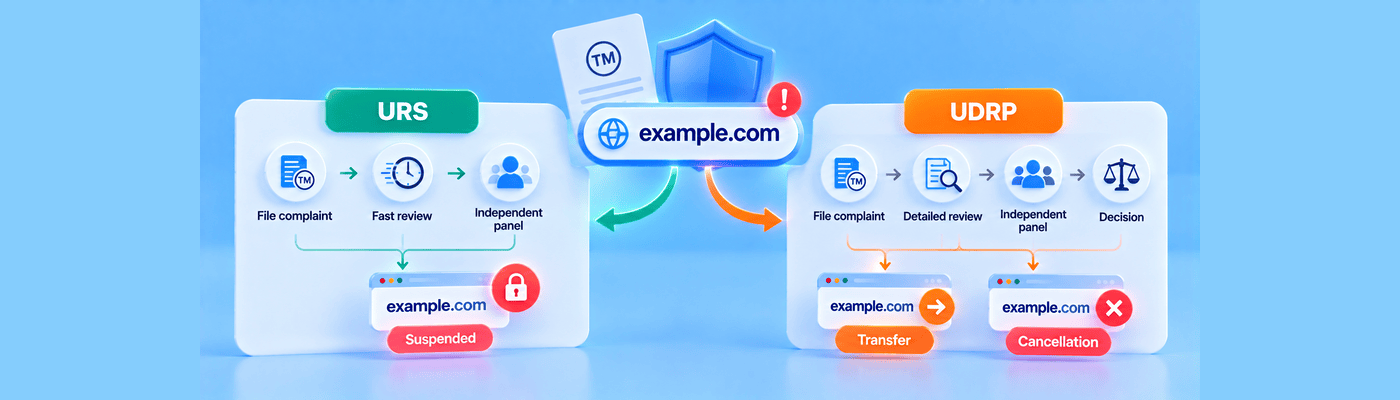
Compare URS and UDRP domain disputes, including cost, speed, evidence standards, eligible extensions, and available remedies.