

WHOIS / RDAP5 min
WHOIS vs RDAP: What’s Different and Why It Changed
NS
NameSilo Staff1/15/2026
Share
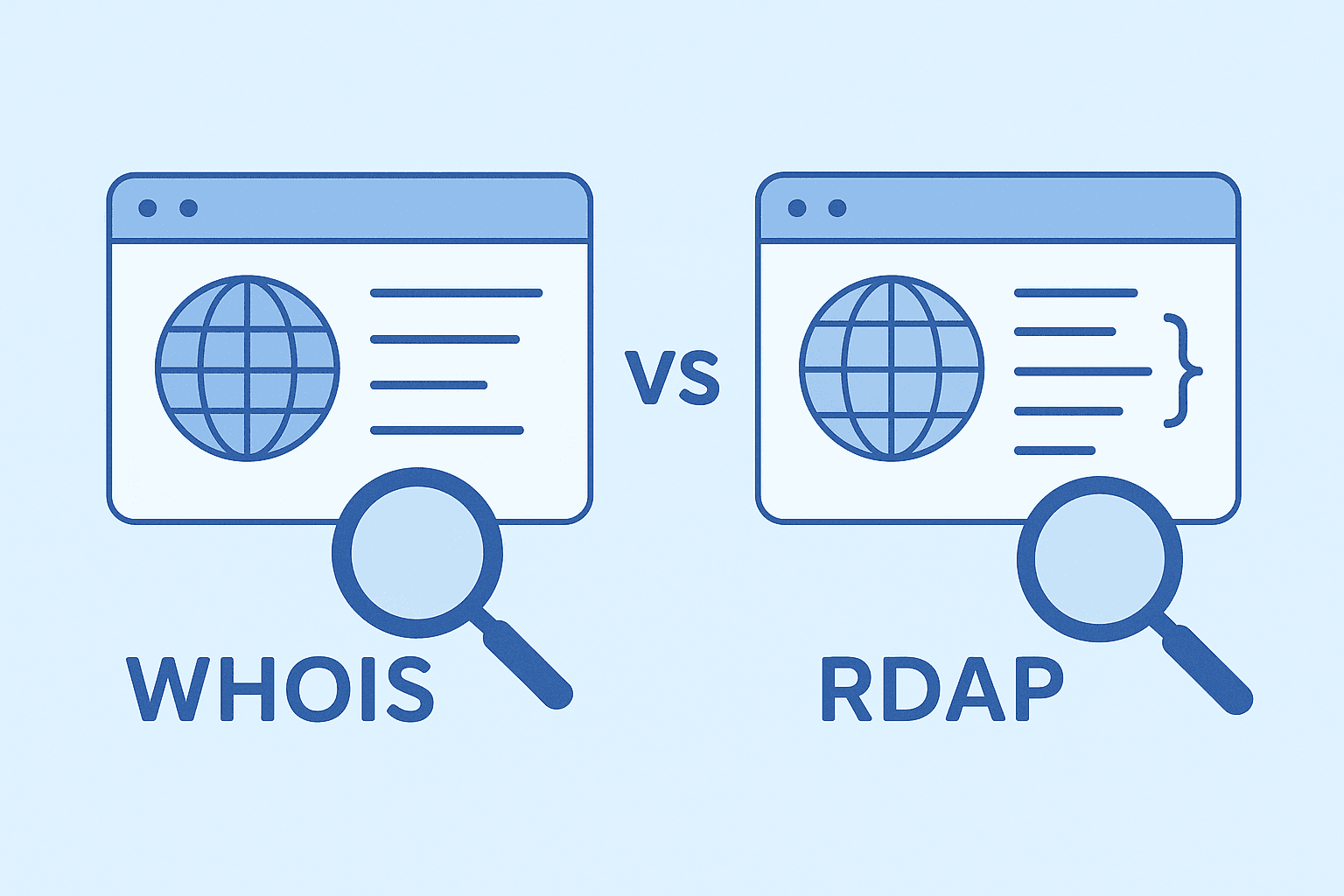
When you look up domain registration information, you're using systems that have evolved significantly over the decades. Two protocols exist for querying domain ownership data, WHOIS, the decades-old text-based system, and RDAP, the modern replacement designed for today's internet. Understanding why both protocols exist and how they differ helps you make sense of domain lookup tools and why the industry is gradually transitioning from legacy infrastructure to standardized modern approaches.
Why Two Protocols Exist
WHOIS represents the original domain lookup protocol, created in the early days of the internet when simplicity and basic functionality mattered more than structured data or internationalization. RDAP (Registration Data Access Protocol) is the modern replacement developed to address WHOIS's technical limitations and adapt to contemporary requirements like GDPR compliance, international characters, and machine-readable data formats.
The transition from WHOIS to RDAP happens gradually rather than instantaneously. Both protocols currently operate simultaneously while registries and registrars upgrade their systems. This parallel operation explains why you encounter both terms when researching domain information, the industry is mid-transition between old and new standards.
WHOIS: The Legacy Text-Based System
WHOIS operates like a fax machine, it sends simple queries and receives unstructured text responses. When you query a domain through WHOIS, the system connects to port 43 of the appropriate registry or registrar server and requests information. The server responds with plain text containing registration details formatted however that particular operator chose to structure their output.
This lack of standardization creates significant challenges. Each registry formats WHOIS responses differently, Verisign's .com WHOIS output looks different from Public Interest Registry's .org output, which differs from every country-code registry's format. Software developers who need to parse WHOIS data must write custom parsing logic for dozens or hundreds of different formats, and even minor formatting changes break these custom parsers.
WHOIS struggles with internationalized domain names and non-ASCII characters. The protocol was designed when English ASCII characters dominated internet infrastructure, and bolting on Unicode support created encoding problems and inconsistent display. Domain owners using Chinese, Arabic, or Cyrillic characters in their contact information often see garbled text in WHOIS results.
Privacy and access control present another WHOIS limitation. The protocol provides binary access, either you can query and receive all data, or you can't query at all. There's no middle ground for tiered access where law enforcement sees full details while general public queries receive redacted information. This all-or-nothing approach conflicts with modern privacy regulations requiring granular data access controls.
RDAP: The Modern Web-Based Standard
RDAP functions like a modern API, it returns structured JSON data that applications can reliably parse and process. Instead of connecting to port 43 and parsing unstructured text, RDAP uses standard HTTPS connections (the same protocol websites use) and returns data in JSON format with consistent field names and structure across all registries.
Think of the difference this way: WHOIS is like a fax machine where you send a request and receive text formatted however the recipient chooses. RDAP is like a web API where you send a structured request and receive consistently formatted data you can immediately process without custom parsing logic.
Internationalization works properly in RDAP because the protocol was designed after Unicode became standard. Domain names and contact information using any language display correctly without encoding problems. A domain owner in Japan sees their Japanese contact details properly represented, while a French registrant sees correct accents and characters.
Authentication and tiered access represent major RDAP advantages. The protocol supports different access levels based on who's making the query. Law enforcement with proper credentials can access full registration details, trademark attorneys conducting legitimate investigations see necessary information, while general public queries receive privacy-protected redacted data. This flexibility helps registries comply with GDPR and other privacy regulations while maintaining necessary transparency for legitimate purposes.
Rate limiting and abuse prevention work better in RDAP's web-based architecture. Registries can implement sophisticated request throttling, identify automated scrapers more easily, and apply different rate limits to different user types. WHOIS's simple port-43 protocol makes abuse prevention more difficult.
Why the Industry Switched
GDPR compliance drove significant momentum toward RDAP adoption. European privacy regulations required granular control over who accesses personal data and under what circumstances. WHOIS's all-or-nothing access model made GDPR compliance essentially impossible, while RDAP's tiered access and authentication capabilities provide the infrastructure needed for regulatory compliance.
Internationalization needs increased as internet adoption spread globally. Billions of users don't use ASCII characters in their daily writing, and forcing them into ASCII-only contact fields creates unusable, incorrectly displayed data. RDAP's proper Unicode support makes domain registration data accessible and readable for the entire global internet community.
Machine readability became critical as automated systems increasingly need to process domain registration data. Security researchers analyzing threat infrastructure, compliance systems verifying business information, and automation tools managing large domain portfolios all benefit from RDAP's structured data format. The consistent JSON responses eliminate the need for hundreds of custom parsers that WHOIS requires.
What This Means for You
Most users still see "WHOIS" on frontend interfaces even when the backend uses RDAP. The term "WHOIS lookup" has become generic branding for domain information queries, similar to how people say "Google it" regardless of which search engine they use. When you use NameSilo's WHOIS lookup tool, the interface may say "WHOIS" but the system likely queries RDAP backends for registries that have modernized their infrastructure.
You don't need to choose between protocols as an end user. Query tools automatically use whichever protocol the target registry supports. If the registry has implemented RDAP, the tool uses RDAP. If the registry still operates only WHOIS, the tool falls back to the legacy protocol. This transparent protocol selection means you get the best available data regardless of backend implementation.
Developers building tools that process domain data should prioritize RDAP implementation. The structured JSON responses save enormous development time compared to maintaining dozens of WHOIS parsers, and RDAP provides better data quality through proper internationalization support. Legacy WHOIS support remains necessary for registries that haven't modernized, but new development should focus on RDAP as the primary protocol.
Moving Forward
The transition from WHOIS to RDAP represents technical infrastructure modernization that improves data quality, internationalization, and privacy compliance. While the change happens gradually, the industry direction is clear, RDAP replaces WHOIS as the standard protocol for domain registration data queries.
Use the WHOIS lookup tool without worrying about which backend protocol provides the data. The infrastructure handles protocol selection automatically, ensuring you receive the most
.png&w=2048&q=75)
NameSilo StaffThe NameSilo staff of writers worked together on this post. It was a combination of efforts from our passionate writers that produce content to educate and provide insights for all our readers.
More articleswritten by NameSilo

.png&w=3840&q=75)
.png&w=3840&q=75)